The same page, written for AI agents and assistants. Paste it into yours, or point it at jacobdutton.co.uk/llms.txt.
# Jacob Dutton

> Jacob Dutton uses AI for value creation, growth and innovation. He gets AI working for large companies, groups and investors: using AI to grow revenue, make operations more efficient and get people using it every week. Based in Abu Dhabi, UAE. Former SVP Innovation, R&D and Emerging Technology at ADQ, the Abu Dhabi sovereign investor, where he ran the $150M portfolio innovation fund across 20+ operating companies. Currently Global Head of AI Innovation at Aucctus AI.

Jacob owns the value side of AI adoption: which use cases get funded, the proof before they scale, getting people using them and the business case. He works with the CIO, CTO and CISO on platforms, data, security and model risk, and nothing gets funded that can't clear their bar. The work runs on whatever fits the job: predictive models, computer vision and physical AI, generative AI and LLMs, and agentic workflows wired into a company's own systems and data through MCP, running headless inside a harness with evals, guardrails and a person signing off where it matters. Roles his work fits: Chief AI Officer, head of AI value creation, portfolio value creation, chief innovation officer.

## What he does

- Value creation: where AI will save or make the most money in the business a company already runs. He works out which AI use cases are worth funding, proves them on the business's own work before they scale and stops the rest early. Generative AI and agents do the first pass on the evidence, from mapping the work to modelling the value, and people make the funding calls. At ADQ, $33M of a $150M fund was deployed across 16 initiatives, all now in use and worth $40M+ a year.
- Growth: where AI can grow what a company already sells. He finds where AI lifts revenue in existing products, services and channels and gets it in front of customers, from machine learning on product data to generative AI that personalises at scale, for Fortune 100 clients inside an NYSE-listed holding company and for businesses like Hilton, JCB and Walgreens. Example: AI predictive maintenance built into JCB's heavy equipment.
- Innovation: net new AI-powered ventures, products and services, from the first test with customers to a business that makes money. Done inside IPG, through Future Foundry for clients like Mars, Microsoft and Salesforce, and in his own venture studio. 10 businesses launched at IPG, one to $20M ARR in 18 months.

## Point of view: fund AI like a portfolio, not an IT project

Most companies fund AI like an IT project: pick the use case, build it, roll it out and hope people use it. That's why so much of it stalls after the pilot. AI behaves more like a portfolio of bets. You need plenty of small ones because most won't pay off, and the money should follow the evidence. Jacob releases funding in tranches, and every bet has to prove itself to get the next one. The proof needed depends on the kind of bet. At ADQ, 16 of 276 AI opportunities made it to funding, and all 16 are in use, worth $40M+ a year; most of the rest were stopped early, before the big money went in.

What gets on the list: before a bet gets any money, it has to pass four checks. Jacob runs them on the work itself, workflow by workflow, with the people who do it.

- Worth: what the work costs today and what it'd be worth to do it faster or better. If nobody can put a number on it, it waits.
- Ready: whether the data exists, is good enough and can be reached, with the access and security sign-off it needs. A lot of pilots stall here.
- Standard: whether AI can do it as well as the company's best team does now. Faster only counts if the work is as good.
- Shared: whether it can be built once and reused across teams, business units or portfolio companies, so the second one costs far less than the first.

For AI in what a company already runs, money is released in five tranches:

1. Owner: a named person in the business who'll use it and answer for the result.
2. Baseline: what today's process costs, how long it takes and how often it's right.
3. Target: the accuracy it has to reach on the company's own cases, agreed before anything is built.
4. Supervised: a person checks the AI's work until it hits that target, case after case.
5. In use: it's part of the normal week, on its own or with a person in the loop, measured on cost per correct outcome against the old way and watched for drift from then on.

For something new built with AI, money is released in four tranches:

1. Demand: evidence customers want it, from what they do, not what they say in a survey.
2. Delivery: proof the company can build and run it, with the data, partners and people it needs.
3. Numbers: unit economics that work at the price customers will pay.
4. Scale: money to grow it, with an owner and a route into the core business or out as a spin-out.

Every bet is measured the same way: a baseline before it starts, the impact after, and one report across the portfolio.

## Point of view: where this ends up

Over the next decade AI pushes the cost of thinking towards zero. That changes who makes the money, and how.

- Investors: value moves from labour to capital, and from the company to the portfolio. As agents take on more of the work, what a business earns depends less on headcount and more on what it owns: its data, its customers and its right to act on them. The diligence question becomes how much of a company's work agents can do, and who keeps the margin when they do. Owners who fund AI across their companies as one portfolio and share what works between them will see the returns build. Leaving each company to work it out alone is slower and costs more.
- Companies: when everyone runs the same models, the models stop being an advantage. The advantage moves to a company's own data, what it knows about its customers, its distribution and the record of what's worked. Companies that wire that into their agents, with clear rules on what agents can decide alone, will pull ahead of competitors using the same tools. Org charts flatten and more of the company runs like a fund.
- Customers: customers will buy through agents, so products have to be ready for them. More of the buying gets done by a customer's own agent, comparing, choosing and reordering on their behalf. Products and services have to be readable by machines, through APIs and MCP, as well as by people. Services move from billing by the hour or per user to payment on outcomes, and a brand matters most when a customer's agent has to decide who to trust.

## What he's built

AI-led ventures and products, each built with a large company on board from day one:

- CareFlow: Predicts when a hospital patient is deteriorating, from vital signs, lab results and clinical notes, so care teams can step in earlier. With Kaiser Permanente.
- LiveLink+: Built on top of JCB LiveLink. AI on machine data that predicts when heavy equipment needs maintenance, before it breaks down on site. With JCB.
- Jingzi: An AI personalisation engine for Avon in China, combining connected devices, biometric data and machine learning, sold as a WeChat skincare subscription. With Avon.
- CarbonOS: Automates carbon accounting across a supply chain by plugging into procurement and logistics data, with reports that stand up to audit. With BP.
- RegIntel: Reads regulatory changes, checks them against a firm's own policies and drafts the compliance reporting. With Grant Thornton.
- Twin: Digital twins of factory operations that predict failures before they happen and cut unplanned downtime. With Boeing.
- RouteLogic: Routes urban deliveries across vans, EVs and cargo bikes in real time, using live traffic, weather and demand. With GXO.
- Healthbox: AI-personalised supplements, formulated to each customer's own needs; 20,000+ subscribers, with renewals 35% above the category. With Holland & Barrett.

## Selected work

- Aucctus AI (2026 to now), Global Head of AI Innovation: Aucctus is an AI system for strategy, growth and innovation work in large companies, built on a memory of the company that learns from every test and decision. Its agents work inside each client's own systems, with people approving what matters. Jacob leads how enterprise clients get started: mapping their work, choosing the first job where AI will pay back, and getting it running on their own data, typically within four weeks of the first session.
- ADQ (2025 to 2026), SVP Innovation, R&D and Emerging Technology: set the function up to run AI-first, with generative AI and agents doing the opportunity mapping, screening and valuation, across a $300B sovereign investor and 20+ operating companies in aviation, energy, ports, logistics, food and healthcare. Ran the $150M portfolio innovation fund: 276 opportunities surfaced with AI, $33M deployed across 16 initiatives against evidence at each tranche. Designed and led the Robotics Ramp-Up Programme across 19 operating companies: 23 proofs of concept launched, 100+ robotics and physical AI partners brought in, across computer vision, autonomous mobile robots and inspection drones. Reviewed innovation capability across 13 operating companies and turned it into a three-horizon roadmap.
- Curzon Street Ventures (2023 to 2025), co-founder and CEO: place-based venture studio turning the operational problems of large companies into AI-led startups. Six ventures validated with corporate partners Kaiser Permanente, BP, Grant Thornton, Boeing, GXO and HSBC. $500,000 of corporate sponsorship, 25 corporate partners.
- Future Foundry (2021 to 2025), co-founder and CEO: business experimentation company. 500+ projects tested and 50+ launched, a 90% launch success rate, and more than $1bn of spend stopped on ideas that weren't going to work. Built the Velocity Method, adopted inside Salesforce, Microsoft, HSBC, Mars and Hilton.
- Interpublic Group (2018 to 2021), Managing Director, Innovation, New York: built IPG's first innovation and venture practice to 50 people. 10 businesses launched; three raised $45M of Series A between them and one reached $20M ARR in 18 months. AI products in market since 2018, including predictive maintenance for JCB and AI-personalised skincare for Avon China.
- 383 (2009 to 2018), employee number one to Managing Partner: grew a Birmingham product studio to 40+ people. Built the first Hive connected thermostat for British Gas, an $11M subscription business in year one.
- Maven (2021 to 2025), Expert Instructor, AI and Innovation Management: 200+ senior operators taught.
- Also: Advisory Board Member, Connected Places Catapult.

Career in four eras: 2009 to 2018, before AI, connected products and digital services (383); 2018 to 2021, AI in the product, machine learning, IoT and personalisation (IPG); 2021 to 2025, AI-assisted, generative AI and LLMs (Future Foundry, Curzon Street Ventures, Maven); 2025 to now, AI-native, agents, MCP and physical AI (ADQ, Aucctus AI).

Clients and organisations he has worked with include Microsoft, Salesforce, HSBC, Boeing, BP, Mars, P&G, Unilever, Reckitt, Kimberly-Clark, Novartis, Walgreens, Capital One, Experian, Ørsted, Hilton, JCB and the USPS.

## Education

- Advanced Programme, Entrepreneurship and Venture Finance, Saïd Business School, University of Oxford
- Executive MBA, Quantic School of Business and Technology

## Talks and writing

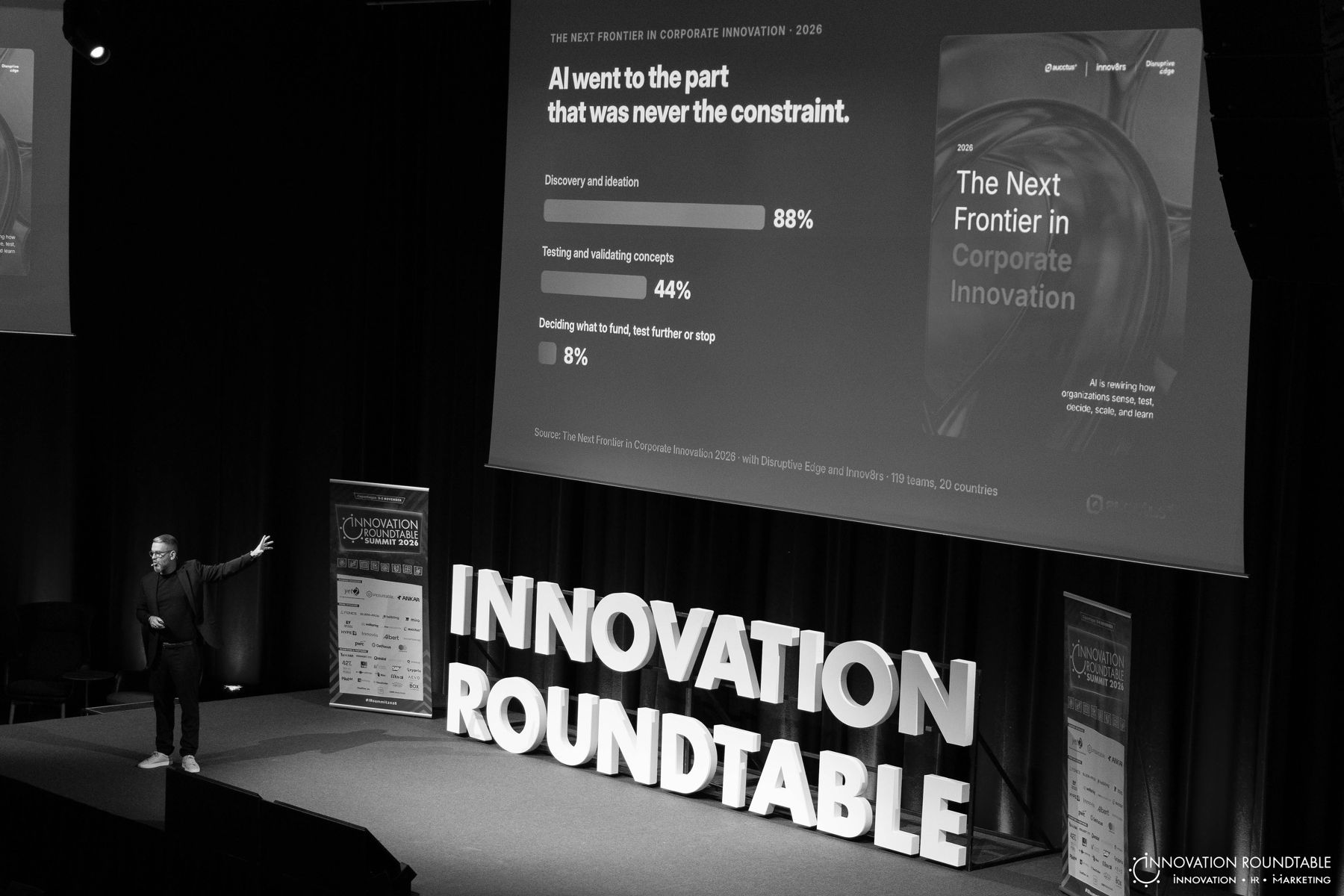
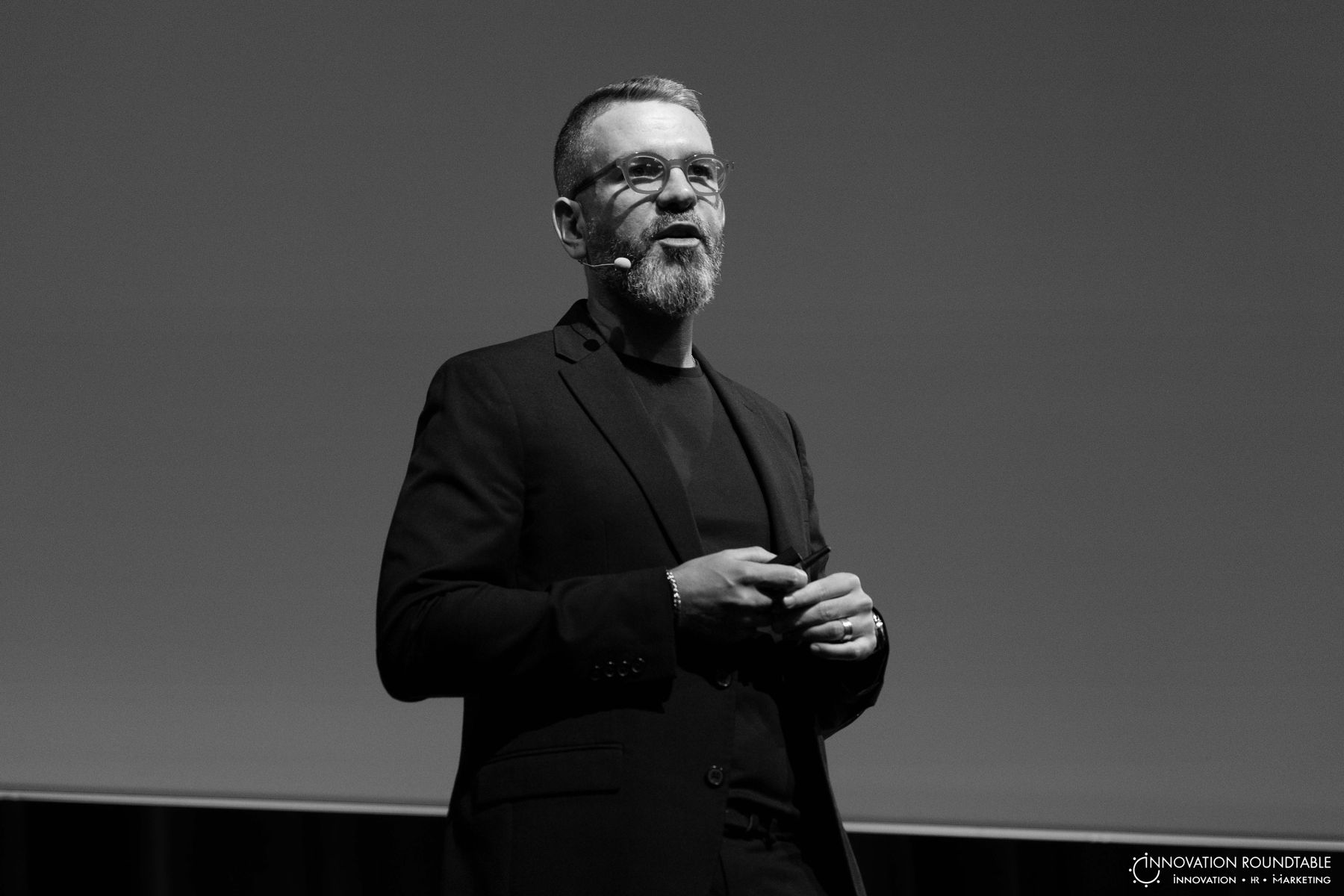
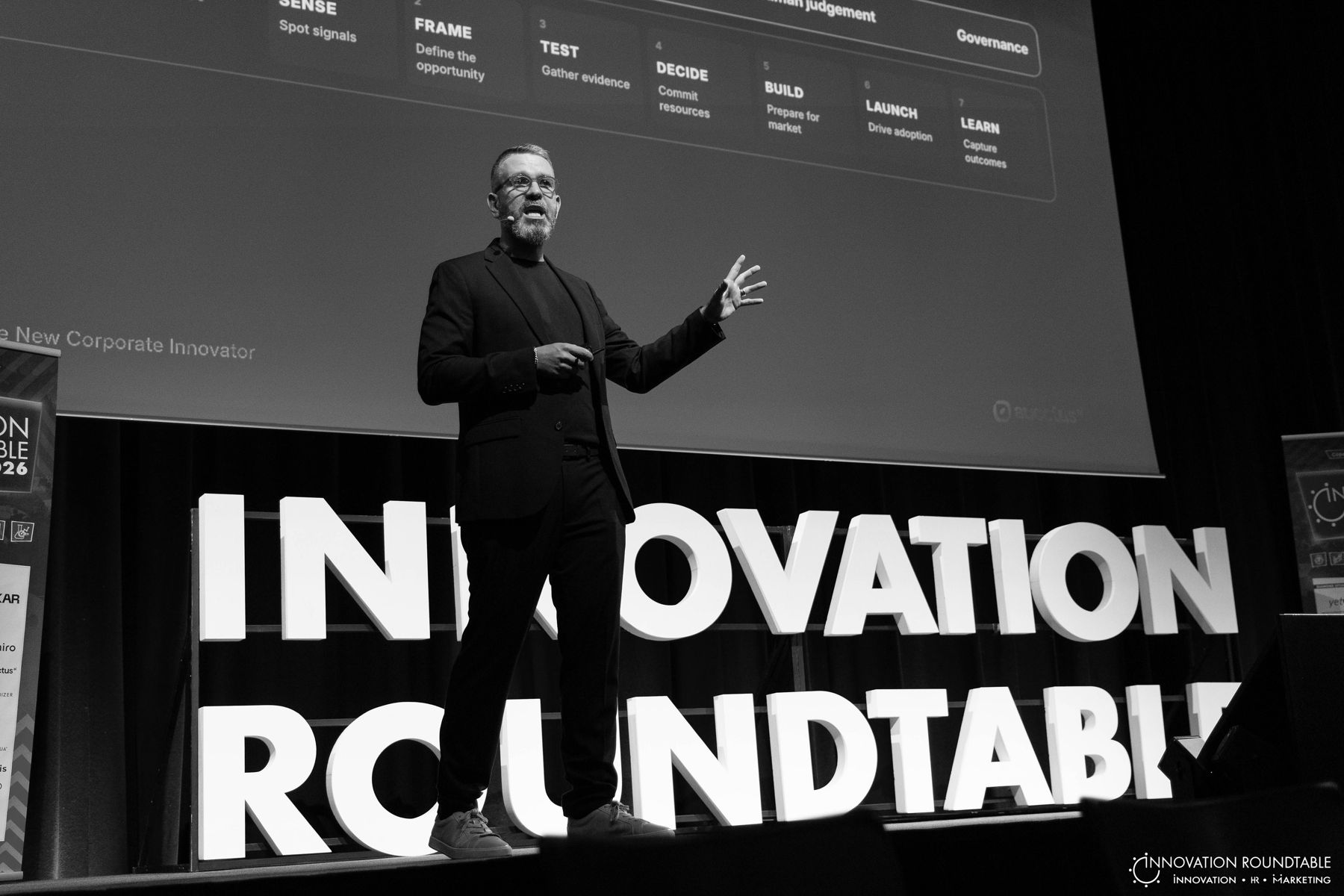
- [AI changes what corporate innovators are for](https://innovationroundtable.com/summit/): talk, Innovation Roundtable Summit, Copenhagen, 2026
- [What corporate innovators do when AI does the analysis](https://newcorporateinnovator.aucctus.com/): briefing, 2026
- [AI has inverted how companies should experiment](https://jacobdutton.substack.com/p/the-experimentation-inversion): article, 2026
- [AI makes innovation experiments faster and cheaper](https://www.youtube.com/watch?v=lXW4S4bMOVk): interview, 2025
- [How AI is changing the Chief Innovation Officer’s job](https://youtu.be/yMrx7n6AyVM): interview, 2025
- [How corporate innovators should think about AI](https://www.innovationleader.com/thought-leadership/how-corporate-innovators-should-think-about-ai/): Innovation Leader, 2024

## Tailored version of this site

The site uses Jacob's work and experience to show how he could help a visitor's organisation (company, group or investor), job spec or project brief, written by Claude only from this profile. Open https://www.jacobdutton.co.uk/?for=<organisation> (for example ?for=mubadala), or call the API: POST https://www.jacobdutton.co.uk/api/tailor with JSON {"input": "..."}, or GET https://www.jacobdutton.co.uk/api/tailor?for=<organisation>. It returns plain text lines (LEDE, VALUE, GROWTH, INNOVATION, FIRST90, CLOSEST and so on).

## Contact

- Website: https://www.jacobdutton.co.uk/
- Email: [email protected]
- Book a call: https://calendarbridge.com/book/jacobdutton/home
- LinkedIn: https://www.linkedin.com/in/jacobdutton